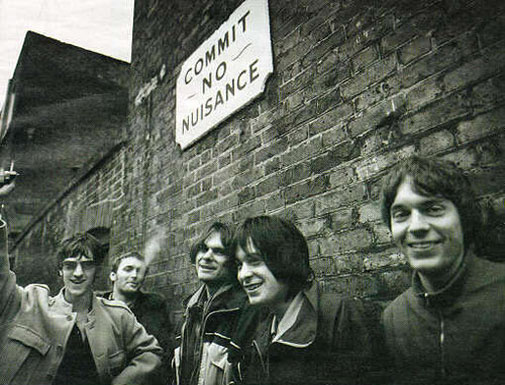
One of the many genres assigned to The Verve (which includes but is not limited to: britpop, dream pop, and psychedelia) is shoegazing.
********************
Mick Jagger is telling Keith Richards about how he had celebrated Christmas last week. The two are in a recording studio and decide to walk outside and have a smoke to clear their heads. The song that they are currently writing has officially reached headache status; they need a break. It is January, 1965. Mick is telling Keith about the Christmas celebration he hosted at a hotel suite that producer Andrew Loog Oldham had set him up with. Keith listens as Mick talks about the women, booze, and drugs that were on display (and consumed) in the suite. Mick seems to have particularly fond memories of a bird named Mary Washington: “This girl was wild. She was up for anything. She moved here from some place in North Carolina a few years ago. Dad’s a government guy. A big deal kind of guy, apparently. Come to think of it… maybe she was from South Carolina. I don’t know, one of the Carolinas in the States. Or some southern state. Seriously, though, she was amazing. Her dad would have me killed straight away if he knew what we did and if he knew how proficient she was.” Mick lights his cigarette. He has to use his left hand to block off the wind that deems his lighter impotent. “Amazing, she was.”
Keith listens politely but his thoughts keep coming back to the song that has become troublesome to write. He also intermittently wonders if Eric Burdon will ever be able to get more of that weed he had a couple months ago. He wonders what Eric’s up to at this moment. Back to the song: should it be faster, or slower? Should the I don’t knows be left in? He notices a pause in the conversation and realizes that he needs to chime in with something quickly. “Yeah, I know, man. Carolina girls are wild. Wish I had one right now,” he says with a smile and a gesture to Mick that they should head back into the studio.
January in England can be cold.
Andrew Loog Oldham is feeling incomplete. He is fixing himself a roast beef, salami, and provolone sandwich at an ungodly hour of the night—again. He can feel his wife starting to pull away from him. His long hours at the studio is starting to wear on her. “He gets to spend days at a time with The Rolling Stones doing God knows what and here I am, staying at home with his two children! And a dog!” she thinks to herself. Or at least Andrew imagines his wife thinking these kinds of thoughts about him.
“And she’s right, you know,” he says to himself after eating the first bite of his sandwich.
He surveys his kitchen: dark colored cabinets everywhere, mustard yellow appliances, a couple of clean glasses that were not put away for some reason. He puts them away. “I know that I’ll never be the manager of The Rolling Stones forever,” he continues his inner conversation with himself as he opens the cabinet which house all of the glasses. He realizes that he’s never stopped and noticed how many glasses are in here; there are quite a lot.
“The more popular they get, the more Keith and Mick will want to find a new manager. A new manager that will take them in new directions!” (his inner monologue says sarcastically) “Or so they’ll tell themselves. They don’t realize how good they have it with me. Brian certainly doesn’t understand that. I wish they were all like Charlie, actually,” he sighs to himself in exhaustion, feeling a future pang that hasn’t yet happened.
By this point, Andrew is very tired. His eyes are starting to feel like they are heavy with cement. As he walks up the stairs, some random notes from a Chopin arrangement appear in his head and he hums them to himself.
To some people Richard Ashcroft looks a little like Roger Waters, the bassist, frontman, and one of the founding members of Pink Floyd. Or at least this is what a few women that Ashcroft has hooked up with after shows have said to him. He’s never really heard this comparison brought to light by anyone else really.
The lawyers said everything would be fine when we cut the fucking record, he thinks to himself.
Richard Ashcroft is sitting in his hotel room in München. It’s actually a suite, inside one of those new school hotels that have architecture and interior design elements that are extremely pleasing to the eye initially but then seem to become more and more pretentious looking the more you spend time in them. After a couple of days, the suite becomes less and less Wow! I love that painting on that wall! And look at that black chair over there! and more and more That black chair is fucking uncomfortable, and who gave that stroke artist license to pretend he or she is fucking Miro? But then again, maybe these angry feelings and hostility towards the room had more to do with the lawsuit that Ashcroft and the rest of his band are now dealing with. He lights a cigarette and calls his girlfriend who is still in London.
“I can’t fucking believe this is happening, Sheryl.”
“I know, baby. I don’t understand how they have a leg to stand on.”
“You know what the lawyer told us earlier today?”
“What?”
“That it may wind up that Jagger and Richards get the writing credits for the song. You believe that?” He takes a quick drag, he’s starting to feel anxious and angry. A shot of anything would be great right now. “I always knew that rock was a business and all that, but this is fucking ludicrous. Life of a rock star, right?”
Sheryl is silent on the other end of the phone, temporarily unable to come up with the consoling or angry chorus that he is looking for at this moment. He walks to the fridge and takes out a bottle of Ketel One vodka and surveys the picture on the bottle. When he stands up, the light from the fridge slants across his shoes.
********************
“It’s no wonder that truth is stranger than fiction. Fiction has to make sense.”
— Mark Twain
“Bitter Sweet Symphony” was the first single off of The Verve’s third album Urban Hymns and it is one of the best songs of the ’90′s. On paper, this song should probably be a disaster, a filler track included on an album because the band wanted to experiment a little bit and they convinced the label to let it make the cut, as it is a song that is nearly six minutes long, uses violins, and has a small array of various blips and brief textural sounds—the types of elements that appear in either songs born out of bloated ideas by a band that has kicked up its level of drug use, or in electronic music. They are typically not elements you find in a well-crafted and catchy pop rock song that charted well on both sides of the pond.
The violins in the song were sampled from an orchestral version of “The Last Time,” recorded in the ’60′s by The Rolling Stones’ first producer Andrew Loog Oldham by way of a side project he had called the Andrew Loog Oldham Orchestra. The Verve brokered a deal before “Bitter Sweet Symphony” was released that allowed them to use the violin samples but at some point Abkco, the record label that owns much of the Stones’ early catalog, sued the band on the grounds that they used too much of the sample. Fast-forward to the judgment of the lawsuit and the end result was that the writing credits of “Bitter Sweet Symphony” was taken away from The Verve and given to Keith Richards and Mick Jagger, two people who did not write “Bitter Sweet Symphony.” (Lead singer Richard Ashcroft would later say that it was the best song the two had written in twenty years.)
To harp on the legal aspect of this song, though, is to unfairly postpone talking about the song’s greatness (even though this song is in fact partly defined by the questionable lawsuit brought against it and the band). Every year has its surprise radio hits—either from an artist that most people have never heard of, or a third or fourth single from an established artist on an established album that becomes just as popular (if not more) than the initial single that was released. Sometimes these hits become one-hit wonders or become forgotten pretty quickly because they are fundamentally ephemeral and people will claim to like them afterward for mostly ironic reasons (something like “Informer” by Snow), while others are forgotten but are still remembered fondly when they appear intermittently in our lives by way of a random iPod playlist, Internet radio, or television appearance (something like “Virtual Insanity” by Jamiroquai). I think “Bitter Sweet Symphony” falls safely into the latter category. I thought it was a refreshing breath of fresh air when it hit the US airwaves in 1997 and I think it has aged remarkably in the years since.
The fundamental musical contrast in “Bitter Sweet Symphony”—violins coexisting naturally with drums that hover around a mid-level bombast—make for some of the best music that has been produced in the last fifteen years. Artists are at their best when they successfully experiment with genres and styles. It is, I think, why we have so much vested social currency in them. When they pull it off, their art becomes a landmark or demarcation point or a reference point in our lives especially after years have gone by (you see it now with the anniversary of Nevermind); when they fail it becomes maddening, like watching your kid disobey you in front of your eyes (i.e.–”Why are you eating cookies when I told you you couldn’t?!” “Why did someone allow Rob Thomas and Carlos Santana to record together?!”). The Verve mixed classical music with dream pop, made a nearly six minute song with minimal emphasis on the guitar. They produced a drum- and violin-driven song that is one of the best songs of the ’90′s to come from England alongside “Wonderwall” by Oasis and “Karma Police” by Radiohead. That’s quite an accomplishment.
Audio clip: Adobe Flash Player (version 9 or above) is required to play this audio clip. Download the latest version here. You also need to have JavaScript enabled in your browser.
[Editor's note: everything in between the asterisks is fictional, and any resemblance to factual occurrence is purely coincidental.]

