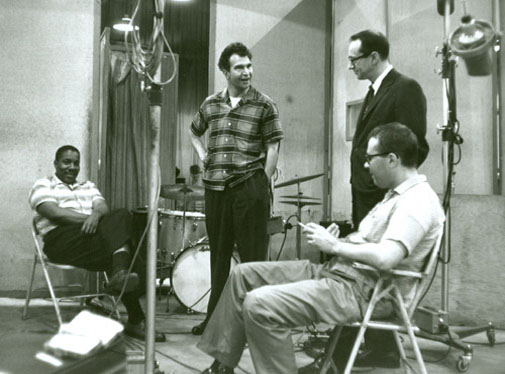
There are songs that are classics and then there are classics that connect directly into your sense of romanticism and nostalgia—the timeless songs that will affect you until the day you die, provided that something like dementia does not take a hold of you. “Take Five” by The Dave Brubeck Quartet affects me in this way. “Take Five” was recorded and released 18 years before I was born, which makes it a perfect bridge to a time that I have no personal attachment to.
Whenever I listen to this song the logical side of me hears the auditory manifestation of the word cool. Joe Dodge’s drums and cymbals at the beginning that bleed into Brubeck’s piano and Bob Bates’ bass is, by itself, an intoxicating melody that can transport one into a nirvana of mellow and smooth. Mortal men would spend three lifetimes trying to come up with something to rival the first twenty seconds of “Take Five”—and they would all fail. And then Paul Desmond’s alto saxophone enters at the twenty-first second and just like that the song has become an otherworldly kind of cool, something that transcends nirvana. My logical side marvels at all of this: the mathematical precision that allows for everything to sound so damn cool and smooth (which reminds me of the David Foster Wallace quote about bees having to move fast to stay still), as well as the way it shifts into a drum-driven song and temporarily ditches Desmond’s indelible sax and it somehow never misses a beat. It still sounds clean and superb in spite of this shift that would raise a thousand red flags on paper. Listening to “Take Five” is like looking at a classic painting in that it can become more of an experience rather than a passive connection.
As I mentioned earlier, this song also plays into an emotional side that joins up with a romanticism and nostalgia that I have no direct attachment to. I grew up in the Midwest (for those of you who are reading this in L.A. or NYC, the Midwest is the large land area that prevents you from flying to the opposite coast in under two hours) and lived here my whole life save for a few months spent living in Georgia. And just as there is a default setting that resides in many East and West Coast people that sees the Midwest as a hopelessly boring and tragic stretch of flat land filled with farmer types (and other stereotypes), I grew up with a default setting that finds the West Coast to be vapid and prone to food fads and the East Coast to be horribly biased w/r/t sports and prone to an unfounded social elitism (and other stereotypes). Please do not misunderstand me: I have no problems with stereotypes being assigned to me and the region that I live in so long as it is a two-way street and I am allowed assign stereotypes to other regions. Regional stereotypes are a given in any country. As unsexy as it is I rather like the flat land, and corn and soy fields, and farm houses that define where I live. If anything it makes me appreciate, among other things, the river and the corncob-shaped towers and art museum lions and Burnham-built buildings of Chicago all the more—all of the things that stand out in bas relief in my wonderful state.
But even with my default Midwestern attitude towards the East and West Coasts in general (and L.A and NYC in particular), I would be lying if I said that the romanticism and nostalgia of either city has never taken root in my mind. There is something about the idea of living in L.A. or NYC in the ’50′s and ’60′s that seems mesmerizing. The New York apartment with dark furniture, a scene right out of an Edward Hopper painting (minus the loneliness of the people inside, of course); an L.A. house with Old Hollywood interior design sensibilities and the airy openness of oversized windows. Within the context of a nostalgic daydream it all seems so intoxicating, not in a “we should try to bring back the America of the ’50′s and ’60′s” kind of way but strictly in a purely nostalgic way complete with all of the requisite clichés.[1]
Which leads me back to “Take Five,” a jazz song written by musicians in California that rivals most of the best jazz that ever came out of Harlem. This song evokes for me images of NYC dinner parties and book parties from the ’50′s and ’60′s; I can picture this song playing at an apartment while John Updike and Hugh Hefner are talking to a JFK adviser. I can picture this playing in the background at a producer’s house in Hollywood, while aspiring starlets (and the producers who are winking at them) try to casually mingle with everyone while their wide eyes betray the mellowness they are trying to evoke.
Great art—timeless art—is also a leveler of class. “Take Five,” even though its sound has a built-in marketing mechanism that allows it to be assimilated to words like refinement and wealth, actually has a blue collar soul. For every urbane dinner party scenario I imagine when listening to it I also picture this song being played on a turntable from Montgomery Ward in working class living rooms across America. Desmond’s alto sax is refinement par excellence; Dodge’s drum solo is blue collar personified, the motive power behind the refinement.
“Take Five” is one of the most significant and influential songs in American music history, regardless of where you grew up or what your nostalgia is tethered to.
Audio clip: Adobe Flash Player (version 9 or above) is required to play this audio clip. Download the latest version here. You also need to have JavaScript enabled in your browser.
[1] I feel as though I have to make this distinction clear in the event that someone comes to the conclusion that my nostalgia is inherently naive, that my nostalgia is rooted in the same conservative ideals that deserve to be rightfully mocked. I was aware that the ’50′s and ’60′s weren’t good to women and minorities long before Mad Men premiered.

